









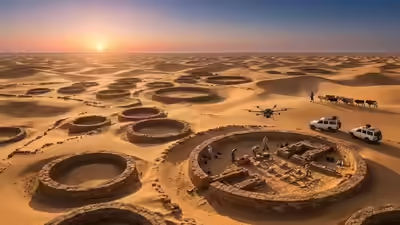
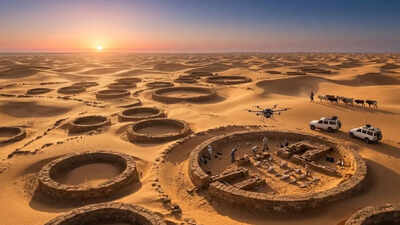
A satellite survey in Sudan’s Atbai Desert has uncovered 280 large stone burial monuments. These findings unveil the social complexity of a long-lost society of cattle herders. The study, published in the African Archaeological Review, explores these structures known as ‘Atbai Enclosure Burials’ (AEBs). Dating back to the Middle and Late Holocene, with diameters reaching up to 82 meters wide. They were constructed between 4500 BCE and 2500 BCE, during the last phases of the African Humid Period. As the Sahara changed from fertile grasslands to an arid desert, these pastoral communities developed sophisticated communal networks. Through coordinated efforts, they built lasting cultural landmarks that highlighted key water sources and grazing areas critical for their survival.
Sudan’s desert reveals 280 massive monuments buried for 6,000 years
The Atbai Enclosure Burials (AEBs) have been newly documented, showcasing monumental architectural feats. These structures vary in size from small rings to large formations spanning 82 meters, as noted in the African Archaeological Review. Each monument is made up of stone-walled enclosures with a variety of internal designs. Some have just one entrance that matches the landscape, while others contain intricate burial clusters. Studies show that building even an average enclosure took more than 160 man-days of labour. This points to a society capable of organizing large communal efforts and planning skillfully, even in tough conditions.
Ritual burials and the afterlife in the Atbai
Archaeologists digging in the AEBs have found that cattle played a central role in the lives of its builders, shaping their society and beliefs. Many of these sites contain both human and cattle burials, with one site having as many as 18 separate graves for cattle. This finding corroborates regional rock art that shows cattle in religious settings; it implies that livestock were more than just food; they represented social status and were interred as symbolic companions into the afterlife. Fewer sheep remains were uncovered, highlighting how important cattle were culturally.
New evidence of long-term habitation in the Atbai region
These 280 monuments weren’t placed randomly. They were intentionally grouped near areas with good access to water. This pattern shows that ancient pastoralists moved with the seasons and set up ceremonial sites where grazing was best. Although the African Humid Period started to end around 3000 BCE, as noted in the African Archaeological Review, it seems these communities stayed in the Atbai region beyond previous chronological estimates. The AEB tradition carried on into the 3rd millennium BCE, showing these societies engineered adaptive strategies with the Sahara’s drying climate over time.